Chinese Bayberry: Origins - Consumption - Nutrition Facts - Health Benefits
|
|
|
Contents
- Geographic origin and regions grown
- History of consumption
- Common consumption today
- Nutritional Facts: Vitamins, minerals and phytochemical components
- Health Benefits: Medicinal uses based on scientific studies
- Bibliography
The Chinese bayberry has been growing in China, Japan and Southeast Asia for at least 2000 years. It is also known as the "yumberry".
Geographic Origins and Regions Grown
 |
 |
Native to eastern Asia, the Chinese bayberry is mainly found in China, where it is known as Yang Mei. It is believed that the same is true for the berry Southeast Asia and in Japan, where it is known as Yamamomo.
The Chinese Bayberry is of significant economical value south of the Yangtze River in China. In Kochi Japan, the Chinese Bayberry flower is the prefectural flower, and the tree itself is the prefectural tree of Tokushima. Old Japanese poems often refer to the name of the plant.
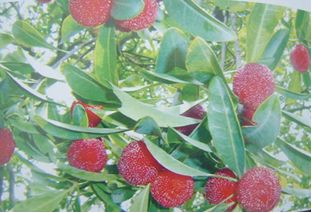
The tree is small to medium in size and grows 10 to 20 meters tall. It is an evergreen, with smooth gray bark and a consistent round or semi-round top. It has separate male and female plants and its root system is shallow, preferring sandy, loamy, or clay soils that must be well drained and preferably acidic or neutral.
History of Consumption
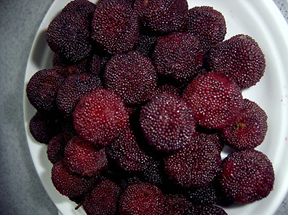
The fruit is one and a half to two and a half centimeters in diameter, with a round, knobby surface that is usually a deep, bright red color, but may vary from white to purple. The fruit’s pulp is similar in color, but may be somewhat lighter, sweet, and very tart.
A single seed that is about half the size of the fruit is located in the center of the berry. In China, the fruits are traditionally eaten as is. The seeds, leaves, and roots are also commonly used for medicinal purposes and the bark of the tree is used as a yellow dye.
Common Consumption Today
Besides being eaten as is, the fruit is also canned, dried, pickled, juiced, and made into alcoholic beverages like wine. The fruit has a very short shelf life, and often attracts insects.
Soaking the fruit in saltwater can help remove the insects prior to its preparation. Due to the problem with insects however, the preferred form of bayberry consumption is as a juice or wine.
The bayberry is now often referred to as the “yumberry” and production in China has increased dramatically over the last decade. Bayberry juice products are also being imported to the U.S. from countries where the Chinese bayberry tree commonly grows.
Nutrition Facts: Vitamins, Minerals and Phytochemical Components
Chinese Bayberries have a good sugar-acid balance and are a source of thiamine, riboflavin, carotene, minerals, dietary fiber, and very high levels of vitamin C. They are also a good source of the same antioxidants (e.g. anthocyanin) that give red wine its health benefits.
In addition to anthocyanins, the bayberry contains flavonols, ellagitannins, and phenolic compounds like gallic acid, quercetin hexoside, quercetin deoxyhexoside, and quercetin. Monosaccharides like rhamnose, arabinose, mannose, glucose, and galactose are found in this berry as well as metal ions like calcium, magnesium, potassium, iron, and copper (1).
The Chinese Bayberry is unusually rich in oligomeric proanthocyanidins (OPCs), the most powerful class of free-radical-scavenging antioxidants. OPCs are believed to support every metabolic system in the body by protecting it against internal and environmental stresses.
Twenty times more powerful than Vitamin C and 50 times more potent than Vitamin E, OPCs are said to defend against cardiovascular diseases, degenerative diseases, and premature aging.
OPCs have also been shown to boost the immune system, lower blood pressure and help lower LDL cholesterol levels. OPCs also increase the strength and elasticity of blood vessels while slowing down the collapse of collagen, keeping skin firm, and inhibit the growth of cancer cells (3).
Chinese-Bayberry-Nutrition-Table
Health Benefits: Medicinal Uses Based on Scientific Studies
Ancient Chinese herbal medicine has relied on its
excellent digestive powers for years. The stem bark is used as an astringent to
treat arsenic poisoning, skin diseases, wounds, and ulcers.
The seed is used to treat sweaty feet and the fruit is used to treat cholera,
heart ailments, and stomach diseases like ulcers.
According to studies, OPCs are highly resistant to free radicals, and since the Chinese Bayberry is rated as one of the most potent antioxidants, it is believed to sweep free radicals completely out of the body. OPCs apparently penetrate the blood-brain barrier, and in turn protect the brain and nervous system (3).
OPCs are also believed to prevent cataracts, aging skin, and may help relieve arthritis. Bayberry juice has even been used to reduce blood pressure, clear blockages, and restore the flexibility of blood vessels. As a treatment for Diabetes Mellitus, bayberry juice helps normalize cells and protect the pancreas.
More recent studies focus on bayberry oil extracts from the leaves. The oil extracts contain myrcene, limonene, alpha-phellandrene, beta-caryophyllene, and caryophyllene oxide, which exhibit anti-fungal and anticarcinogenic properties (4), (5).
Studies have also shown that extracts and oils from bayberry leaves exhibit acaricidal, insecticidal, pesticidal, and arthropod repellent properties (2).
Bibliography
- Fang Z, Zhang M, Tao G, Sun Y, Sun J. (2006) Chemical composition of clarified bayberry (Myrica rubra Sieb et Zucc.) juice sediment. Journal of agriculture and food chemistry, 54(20):7710-6.
- Jaenson TG, Paelsson K, Borg-Karlson AK. (2005) Evaluation of extracts and oils of tick- repellent plants from Sweden. Medical and VeterinaryEntomology, 19(4):345-52.
- Kuo PL. Hsu YL, Lin TC, Lin LT, Lin CC. (2004) Induction of apoptosis in human breast adenocarcinoma MCF-7 cells by prodelphinidin B-2 3,3'-di-O-gallate from Myrica rubra via Fas-mediated pathway. Journal of pharmacy and Pharmacolog, 56(11):1399-406.
- Stuart AE. (1998) The anti-fungal effect of oil distilled from the leaves of Myrica gale. Planta Medica, 64(4):389
- Sylvestre M, Legault J, Dufuor D, Pichette A. (2005) Chemical composition and anticancer activity of leaf essential oil of Myrica gale L. Phytomedicine, 12(4):299-304.
Disclaimer
Nutritiousfruit.com provides this website as a service. Although the information contained within the website is periodically updated, no guarantee is given that the information provided is correct, complete, and/or up-to-date. The materials contained on this website are provided for general information purposes only and do not constitute legal or other professional advice on any subject matter. Nutrtiousfruit.com does not accept any responsibility for any loss, which may arise from reliance on information contained on this website. The information and references in this website are intended solely for the general information for the reader. The content of this website are not intended to offer personal medical advice, diagnose health problems or to be used for treatment purposes. It is not a substitute for medical care provided by a licensed and qualified health professional. Please consult your health care provider for any advice on medications.
Didn't find what you were looking for? Search here...

Amazon Search Box:
Did you like this page?
|
|
|

Hi, Phillip here, thanks for visiting my page. I am the publisher of NutritiousFruit.com
where my primary goal is to provide information about fruit and their nutritional benefits to readers based on research from online sources. Read more...

 On Sale: Nutritious Fruit Snack Recipes