Guava: Origins - Consumption - Nutrition Facts - Health Benefits
|
|
|
Contents
- Geographic origin and regions grown
- Common consumption today
- Nutrition Facts: Vitamins, minerals and phytochemical components
- Health Benefits: Medicinal uses based on scientific studies
- Bibliography
Geographic Origins and Regions Grown
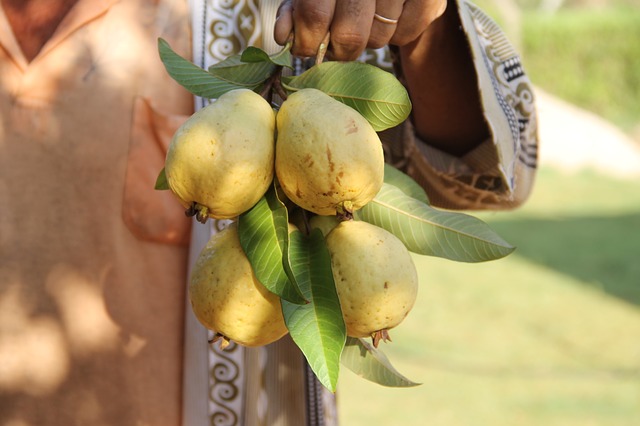
If you go hunting for guava you might be amazed to find that there are approximately 100 varieties of these tropical shrubs and small trees. It is native in the Americas from Mexico to the northern parts of South America, including the Caribbean. Guavas are cultivated in many tropical and subtropical countries. Guava is a common fruit throughout most tropical regions.
The guava fruit expands in flavor from a tad bitter at the rind to varying sweetness in the flesh with the center being the sweetest. Guavas are oval or round and can range in appearance from yellow to red and even purple-black. The flesh can vary just as much with the lightest color being pale yellow to the darkest color being bright red.
Common Consumption Today
Guava is usually consumed whole; however, it lends itself well as an ingredient in many dessert dishes. My favorite is a tropical fruit salad combined with a cake mix, for example pineapple upside down cake style. Add a cinnamon crumb topping or just drizzle with a sweet frosting or sauce (alright, how about crumb topping and sweet frosting) and you have something excellent for tea time.
Dipping fresh guava in salt or prune powder is common in Asia, as is cooking it down to make various candies, preserves, and juices. The fruits and leaves of this plant make a wonderful tea as well. The Cuban’s use the leaves in barbecues to smoke meat and thus lend to its flavor and scent.
Guava juice is becoming more and more popular in many parts of the world. You’re sure to see bottles of flavored waters and juices that feature guava in many specialty shops and grocery stores. I always love having guava juice because you know you are drinking a smart, fibrous drink.
A variety of guavas add to the culinary experiences for the palate. Red guavas in substitution for tomatoes are used as the base of salted items such as sauces, especially for those sensitive to the tomato’s acidity.
Unfortunately the removal of the seeds is quite an annoying task. You could eat a whole guava if you wanted to, but you would probably waste a good deal of the pulp while you are trying to cut out the hard seeds.
Nutrition Facts: Vitamins, Minerals and Phytochemical Components
Guavas are often ignored, but they are one of Mother Nature's most potent healing agents. They are inexpensive, and their benefits are valuable. Nutritionally they have more fiber than prunes and are an excellent source of soluble fiber, which is known to help prevent gastrointestinal cancers as well
as lower cholesterol levels. Several vitamins and minerals including potassium, beta carotene, calcium, folate, iron, lycopene, vitamins A-C, are present in guava.
If the Fountain of Youth is what you seek, guava’s vitamin B retards the oxidation of cells. The powerful antioxidants of its carotenoids (vitamin A) provide skin-smoothing, moisturizing properties and protection against environmental toxins.
Vitamin C stimulates the assembly of collagen and assists with the building and maintaining of skin, blood vessels, joints, and cartilage. In addition to building the body, Vitamin C has properties of antihistamine and assists with balancing pollutants; this protects the skin from various skin conditions such as psoriasis, eczema and hives. The level of vitamin C in the edible rind of the guava is five times higher than that of an orange.
Health Benefits: Medicinal Uses Based on Scientific Studies
To repair skin damaged by the sun, a poultice of guava might do the trick. Certain bacteria may even be combated through a diet including guava fruit as well.
Leaves are used to remedy diarrhea (1) and for the benefits of antimicrobial properties. We have to remember all good things in moderation though. There are indications that the same properties controlling diarrhea (2) may also cause constipation if you were to eat too much of the fruit.
Recent findings indicate that Guava could help diabetics with its sugar-lowering (2), (3). Although guava is known for producing many health benefits, if used daily, it can potentially be harmful to the skin.
Bibliography
1. Abreu, P. R., Almeida, M. C., Bernardo, R. M., Bernardo, L. C., Brito, L. C., Garcia, E. A., et al. (2006). Guava extract (Psidium guajava) alters the labelling of blood constituents with technetium-99m. Journal of Zhejiang University Science B, 7(6), 429-435.
2. Hsieh, C-L, Lin, Y-C, Yen, G-C, & Chen, H-Y. (2007). Preventive effects of guava (Psidium guajava L.) leaves and its active compounds against α-dicarbonyl compounds-induced blood coagulation. Food Chemistry, 103(2), 528-535.
3. Mukhtar, H. M., Ansari, S. H., Bhat, Z. A., Naved, T., & Singh, P. (2006). Antidiabetic activity of an ethanol extract obtained from the stem bark of Psidium guajava (Myrtaceae). Die Pharmazie, 61(8), 725-727.
Disclaimer
Nutritiousfruit.com provides this website as a service. Although the information contained within the website is periodically updated, no guarantee is given that the information provided is correct, complete, and/or up-to-date. The materials contained on this website are provided for general information purposes only and do not constitute legal or other professional advice on any subject matter. Nutrtiousfruit.com does not accept any responsibility for any loss, which may arise from reliance on information contained on this website. The information and references in this website are intended solely for the general information for the reader. The content of this website are not intended to offer personal medical advice, diagnose health problems or to be used for treatment purposes. It is not a substitute for medical care provided by a licensed and qualified health professional. Please consult your health care provider for any advice on medications.
Didn't find what you were looking for? Search here...

Amazon Search Box:
Did you like this page?
|
|
|

Hi, Phillip here, thanks for visiting my page. I am the publisher of NutritiousFruit.com
where my primary goal is to provide information about fruit and their nutritional benefits to readers based on research from online sources. Read more...


 On Sale: Nutritious Fruit Snack Recipes