Pomegranate: Origins - Consumption - Nutrition Facts - Health Benefits
|
|
|
Contents
- Geographic origin and regions grown
- History of consumption
- Common consumption today
- Nutrition Facts: Vitamins, minerals and phytochemical components
- Health Benefits: Medicinal uses based on scientific studies
- Bibliography
Geographic Origins and Regions Grown
History of Consumption
Here’s another quite familiar exotic fruit: the pomegranate. It originated in the Middle East in areas from Afghanistan or Iran all the way to northern India in the Himalayas. Since ancient times it has been produced throughout the Mediterranean and the Caucasus.
Spanish settlers are responsible for its introduction to the Americas, specifically to Latin America and California in 1769. Today in dry parts of California and Arizona you can see the fruit being cultivated still for exportation since the popularity of pomegranate juice rose in the early 2000’s. It is a super-fruit, undeniably so.
Just how popular is the Pomegranate?
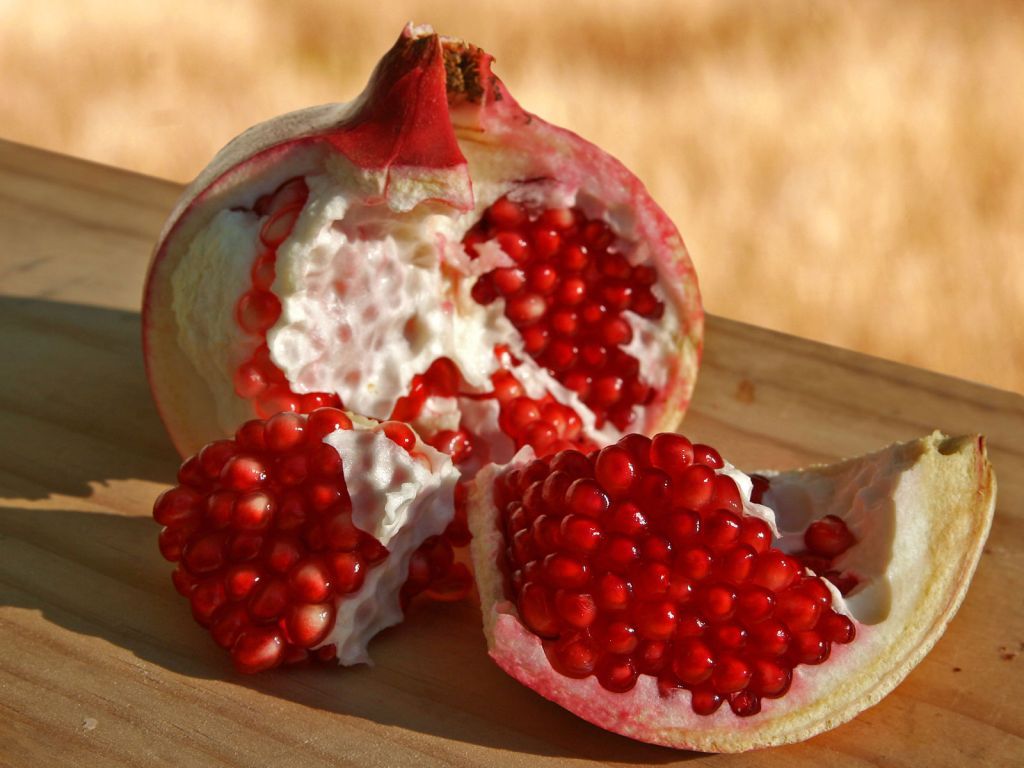
Well it is the topic of a plethora of epics and myths: think Shakespeare or Homer. And artistically the pomegranate has been recognized by Cezanne, Raphael, and various others. It is even possible that Eve gave Adam a pomegranate instead of an apple in the Garden of Eden. It is believed to be one of the world's first domesticated crops. But really, there are no words to describe it. Look at that picture.
Common Consumption Today
The pomegranate looks like it would be a fruit that is very complex but it is easy to make this fruit a delicacy of different sorts. Break open the pomegranate by peeling it using a knife, just like peeling an orange. The purpose is to differentiate the seeds from the pith and the peel.
The pomegranate has the look of a complex fruit but there is an easy approach to getting at the heart of this delicacy. Score the peel with a knife as you would an orange and break it open. Your goal is to separate the seeds from the peel and pith. To achieve this, scoop the fruit (everything, including the pith), from the peel and submerge it in water. The pith will rise to the top while the seeds will sink to the bottom.
When eaten raw, the fleshy external part of a seed is the most important part. However you can enjoy the entire seed without worry. Always remember the ripeness and type of pomegranate will have an impact on taste, which can range from very sweet to very sour. Usually the fruit is at a happy medium of a simple sweet with a hint of tang from the tannins.
Pomegranate is a staple all over the world. Outside of the ever-growing and popular juice market, pomegranate is common in Indian and Iranian cooking and has gained popularity in the US in the last few years for this reason as well. A concentrate of pomegranate can also be included in such cuisines as Syrian. Something you may have in your pantry is grenadine syrup which is a sweetened and thickened pomegranate juice for cocktails.
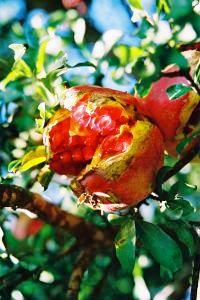
The Middle East relied on Grenadine syrup for use in almost all Persian foods before the arrival of the tomato. It is still used in traditional Mid-Eastern cuisine today. In need of a spice? The wild pomegranate (daru), located in the Himalayas, is gathered for use of the seeds from a spice called anardana – meaning “pomegranate seeds” in Persian.
Anardana is used in Pakistani and Indian cuisine and serves well as a substitute for syrups containing pomegranate. Anardana can be found in markets of the ethnic persuasion, if you ever find yourself in need of this spice for cooking a chutney or curry. It is advisable to grind the seeds as they sometimes end up wedged in the teeth.
From beverages, salad dressings and salads to main dishes and desserts, the pomegranate has cornered the market in being a well sought after commodity. New markets address the advantages of using extracts of the fruit (free of additives, sugar and calories) to enhance their products, such as packaged food and dietary supplements.
The producers of dietary and food supplements have discovered the benefits of including extracts of pomegranates, instead of the juices, as strong ingredients in the product.
Nutrition Facts: Vitamins, Minerals and Phytochemical Components
Pomegranate juice contains 16% of the required daily vitamin-C intake and is a great source of vitamins A, B, and E, potassium, hydrolysable tannins, pantothenic acid, ellagic acid, flavonoids and polyphenols. The antioxidant levels of a pomegranate is said to contain three times more than green tea or red wine.
Health Benefits: Medicinal Uses Based on Scientific Studies
In times long ago, the pomegranate used to aid many sicknesses. The Egyptians, and Greeks would use the pomegranate for fertility enhancement, Hippocrates professed that it would aid with the digestion process, and India would use it for heart problems.
The antioxidants that pomegranates produce can assist with the prevention of arteries hardening, heart disease (6), (7), (8), a few types of cancer, such as, lung, colon, breast and prostate and osteoarthritis (1), (2), (3). Also, pomegranate juice can affect lymphoma, erectile dysfunction (9), leprosy, dyspepsia, dental plaque (12), diabetes (10), and prostatic hyperplasia.
Extracts of leaves, the bark and immature fruit give astringents to stop diarrhea, hemorrhages and dysentery. Pulverized and dried buds from the flower can be used to assist in the aid of bronchitis. In some places, such as Mexico, the flowers are made into a tea that is gargled to cure throat and oral inflammation. Also, the bark of the root and stem contain many alkaloids that act against tapeworm.
Applying the pomegranate topically can improve the health of skin against damaged caused from ultraviolet light (13), it can also show signs of reversing age by the promotion of thickening the outer layer of the skin and it also provides support nutritionally for fibroblast cells.
Pomegranate’s phenolic compounds promote wound-healing effectively (11). Researchers in India said that a topical pomegranate cream reduces the time required for complete recovery of an excision wound by around 35% (4), (5).
Bibliography
- Adams, L. S., Seeram, N. P., Aggarwal, B. B., Takada, Y., Sand, D., & Heber, D. (2006). Pomegranate juice, total pomegranate ellagitannins, and punicalagin suppress inflammatory cell signaling in colon cancer cells. Journal of Agricultural Food and Chemistry, 54(3), 980-985.
- Afaq, F., Saleem, M., Krueger, C. G., Reed, J. D., & Mukhtar, H. (2005). Anthocyanin and hydrolyzable tannin-rich pomegranate fruit extract modulates MAPK and NF-kappaB pathways and inhibits skin tumorigenesis in CD-1 mice. International Journal of Cancer, 113(3), 423-433.
- Albrecht, M., Jiang, W., Kumi-Diaka, J., Lansky, E. P.,Gommersall, L. M., Patel, A., et al. (2004). Pomegranate extracts potently suppress proliferation, xenograft growth, and invasion of human prostate cancer cells. Journal of Medicinal Food, 7(3), 274-283.
- Ashoori, F., Suzuki, S., Zhou, J. H., Isshiki, N., & Miyachi, Y. (1994). Involvement of lipid peroxidation in necrosis of skin flaps and its suppression by ellagic acid. Plastic and Reconstructive Surgery, 94(7), 1027-1037.
- Aslam, M. N., Lansky, E. P., & Varani, J. (2006). Pomegranate as a cosmeceutical source: pomegranate fractions promote proliferation and procollagen synthesis and inhibit matrix metalloproteinase-1 production in human skin cells. Journal of Ethnopharmacology, 103(3), 311-318.
- Aviram, M. & Dornfeld, L. (2001). Pomegranate juice consumption inhibits serum angiotensin converting enzyme activity and reduces systolic blood pressure. Atherosclerosis, 158(1), 195-198.
- Aviram, M., Dornfeld, L., Kaplan, M., Coleman, R., Gaitini, D., Nitecki, S., et al. (2002). Pomegranate juice flavonoids inhibit low-density lipoprotein oxidation and cardiovascular diseases: studies in atherosclerotic mice and in humans. Drugs Under Experimental and Clinical Research, 28(2-3),49-62.
- Aviram, M., Dornfeld, L., Rosenblat, M., Volkova, N., Kaplan, M., Coleman, R., et al. (2000). Pomegranate juice consumption reduces oxidative stress, atherogenic modifications to LDL, and platelet aggregation: studies in humans and in atherosclerotic apolipoprotein E-deficient mice. American Journal of Clinical Nutrition, 71(5), 1062-1076.
- Azadzoi, K. M., Schulman, R. N., Aviram, M., & Siroky, M. B. (2005). Oxidative stress in arteriogenic Erectile Dysfunction: Prophylactic role of antioxidants. Journal of Urology, 174(1), 386-393.
- Esmaillzadeh, A., Tahbaz, F., Gaieni, I., Alavi-Majd, H., & Azadbakht, L. Concentrated pomegranate juice improves lipid profiles in diabetic patients with hyperlipidemia. Journal of Medicinal Food, 7(3), 305-308.
- Murthy, K. N., Reddy, V. K., Veigas, J. M., & Murthy, U. D. (2004). Study on wound healing activity of punica granatum peel. Journal of Medicinal Food, 7(2), 256-259.
- Sastravaha, G., Yotnuengnit, P., Booncong, P., & Sangtherapitikul, P. (2003). Adjunctive periodontal treatment with Centella asiatica and Punica granatum extracts: A preliminary study. Journal of the International Academy of Periodontology, 5(4), 106-115.
- Syed, D. N., Malik, A., Hadi, N., Sarfaraz, S., Afaq, F., & Mukhtar, H. (2006). Photochemopreventive effect of pomegranate fruit extract on UVA-mediated activation of cellular pathways in normal human epidermal keratinocytes. Photochemistry and Photobiology, 82(2), 398-405.
Disclaimer
Nutritiousfruit.com provides this website as a service. Although the information contained within the website is periodically updated, no guarantee is given that the information provided is correct, complete, and/or up-to-date. The materials contained on this website are provided for general information purposes only and do not constitute legal or other professional advice on any subject matter. Nutrtiousfruit.com does not accept any responsibility for any loss, which may arise from reliance on information contained on this website. The information and references in this website are intended solely for the general information for the reader. The content of this website are not intended to offer personal medical advice, diagnose health problems or to be used for treatment purposes. It is not a substitute for medical care provided by a licensed and qualified health professional. Please consult your health care provider for any advice on medications.
Didn't find what you were looking for? Search here...

Amazon Search Box:
Did you like this page?
|
|
|

Hi, Phillip here, thanks for visiting my page. I am the publisher of NutritiousFruit.com
where my primary goal is to provide information about fruit and their nutritional benefits to readers based on research from online sources. Read more...

 On Sale: Nutritious Fruit Snack Recipes